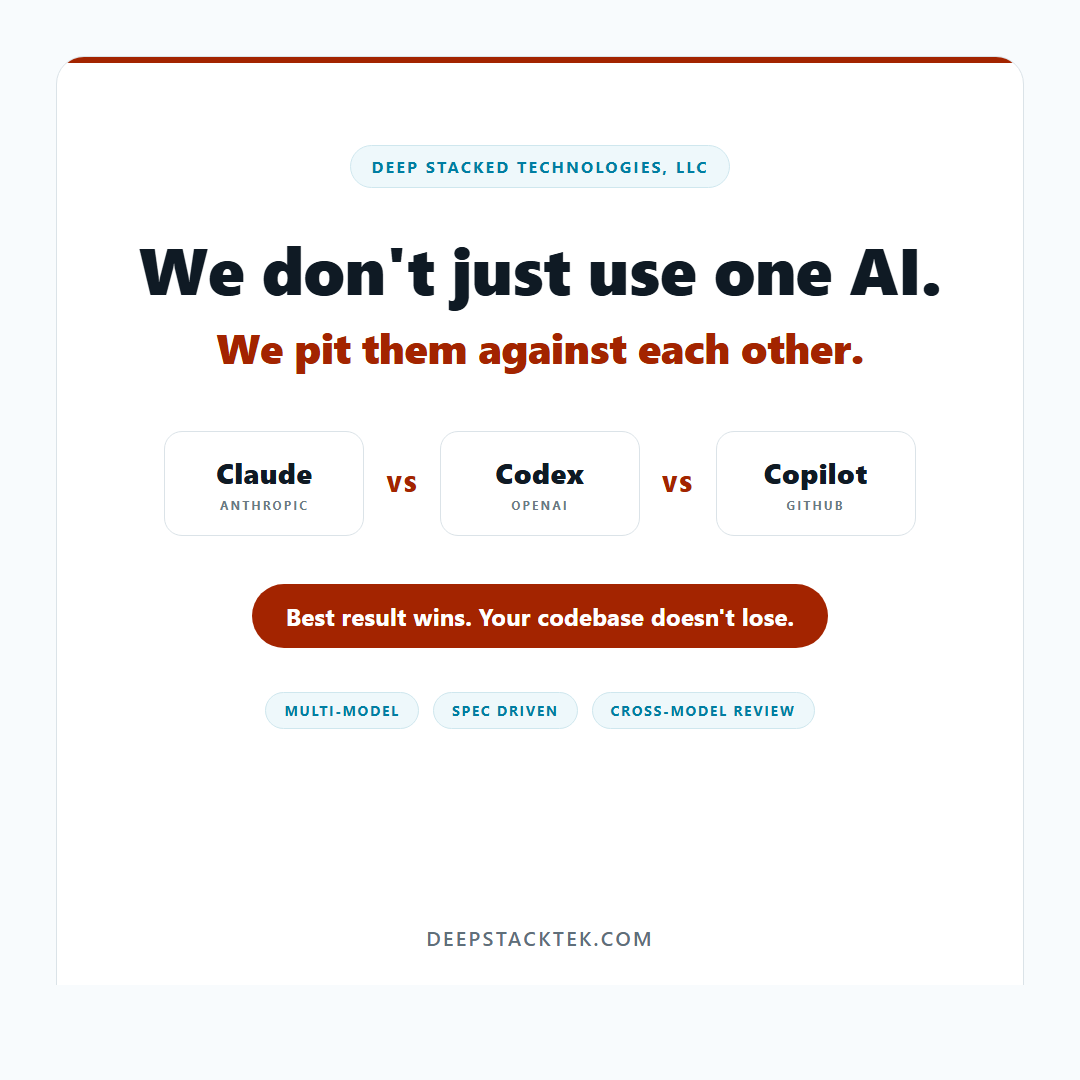
Most shops betting on AI pick one model, wire it up, and hope for the best. We run Claude, Codex, and Gemini against each other on every change, because a single model’s blind spots should never be the thing that ships to your production stack.
Every model has a bad day
Claude thinks differently than Codex. Codex thinks differently than Gemini. Each has strengths. Each has failure modes. When you rely on one model you inherit its weaknesses without knowing it, because you never see the diff against a second opinion.
Running multiple models against the same spec surfaces those weaknesses fast. If two models agree and one disagrees, that disagreement is almost always where the bug is.
Cross-model review, built into the pipeline
At Deep Stacked Technologies cross-model review is not a nice-to-have, it is a step in the pipeline. Code from one model is reviewed by the others against the spec. Disagreements get flagged for a human. Consensus gets tested. Only then does anything land in your repo.
This is AI as an autonomous operator, not autocomplete. The models negotiate, argue, and converge on an answer that a human can defend.
What this means for your business
You get the best of every model, not the blind spots of one. Fewer late-night fires. Fewer rewrites. A codebase that holds up when your next customer hits the edge case that one model would have missed.
Real Engineering. Real Results.
Want multi-model review on your stack? Book a discovery call.